
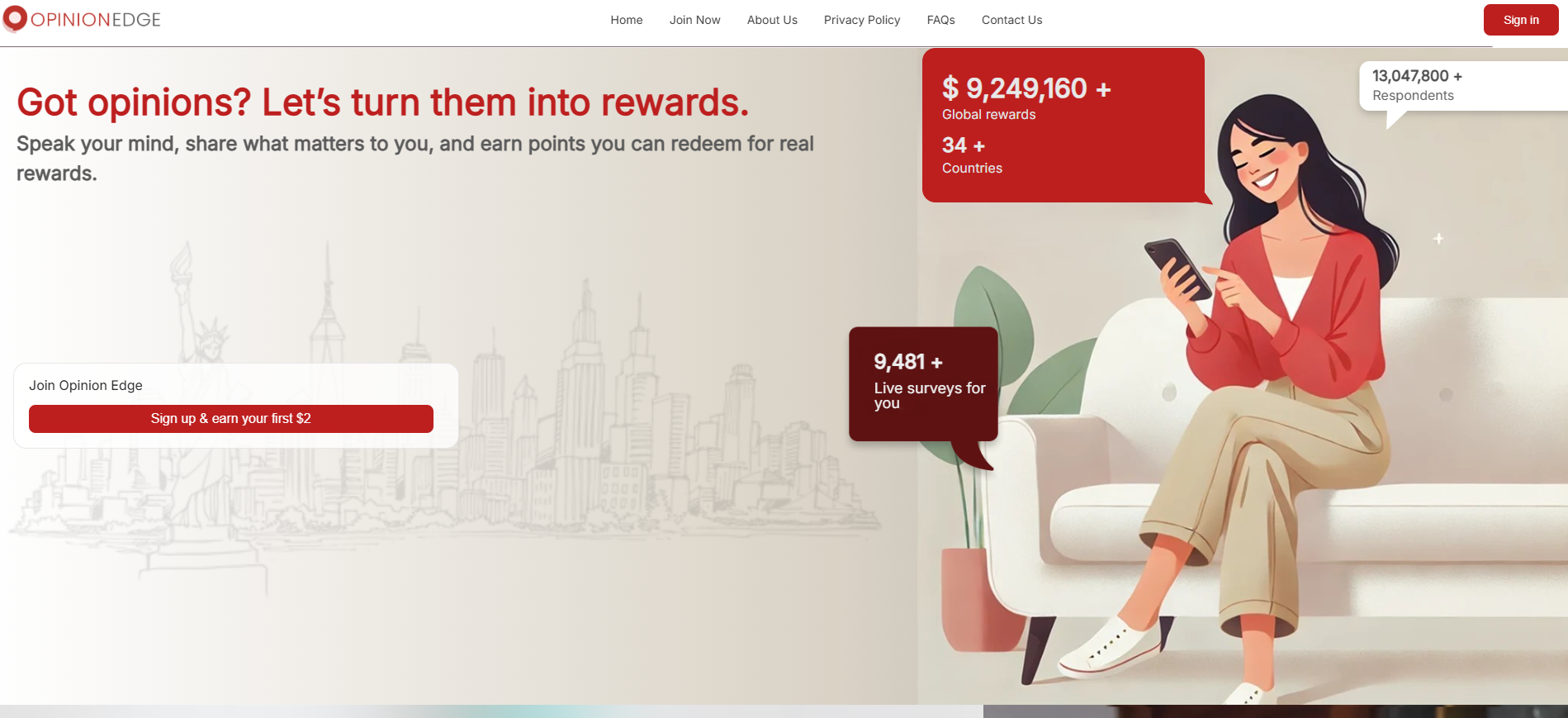
The AI-Powered Pulse of Public Sentiment in 2025
In the hyper-connected ecosystem of 2025, where every click, swipe, and voice command generates data, Opinion-Edge.com has emerged as the sharpest blade in real-time sentiment intelligence. Launched in 2022 as a niche AI analytics platform, Opinion Edge has rapidly scaled into a mission-critical tool for political campaigns, Fortune 500 brands, crisis communicators, and media strategists. By fusing generative AI, natural language processing (NLP), and a proprietary “EdgeScore” algorithm, the platform distills billions of unstructured online conversations into actionable, predictive insights—often within minutes of a trending event.
As of November 2025, Opinion Edge reports 42 million daily processed interactions across 180+ countries, with enterprise clients including three of the top five global PR firms and two major U.S. presidential transition teams. The company’s valuation crossed $1.4 billion after a Series C round led by Sequoia Capital and Singapore’s Temasek in Q3 2025, reflecting investor confidence in AI-driven public opinion infrastructure.
This 1,100-word deep dive explores Opinion Edge’s origins, breakthrough technology, core applications, ethical framework, competitive positioning, and the controversies that shadow its meteoric rise.
From Startup Garage to Sentiment Oracle: The Founding Story
Opinion Edge was born in a converted warehouse in Austin, Texas, during the chaotic 2021-2022 “infodemic.” Co-founders Dr. Maya Patel, a former Google NLP researcher, and Javier Morales, a veteran Democratic digital strategist, observed a critical gap: traditional polling lagged 7–14 days behind viral narratives, rendering insights obsolete in the TikTok era.
Their epiphany came during the 2021 Virginia gubernatorial race. A single parental rights soundbite exploded on social media, shifting momentum overnight—yet polls only registered the swing a week later. “We realized,” Patel later told TechCrunch, “that the future of public opinion isn’t in asking people what they think—it’s in listening at scale to what they’re already saying.”
By mid-2022, the duo had assembled a 12-person team and launched Opinion Edge Alpha, a beta tool that scraped public Reddit, Twitter (now X), and Facebook comments to generate hourly sentiment heatmaps. Early adopters—local journalists and mid-tier political consultants—praised its speed but criticized noise. Version 1.0, released in January 2023, introduced EdgeScore, a 0–100 predictive metric that forecasts narrative momentum 24–72 hours ahead with 87% accuracy in back-tested elections.
The breakthrough caught Silicon Valley’s eye. A $45 million Series A in 2023 fueled global language expansion (now supporting 42 languages, including Hindi, Arabic, and Tagalog). By 2024, Opinion Edge had processed sentiment from 1.2 billion social interactions, earning its first enterprise contract with a major airline during a PR crisis over flight cancellations.
The Tech Stack: How EdgeScore Predicts the Unpredictable
At the heart of Opinion-Edge.com lies a three-layer AI architecture:
1. Ingestion Layer
A distributed crawler network pulls public, non-paywalled data from 180+ platforms: X, Reddit, TikTok comments, YouTube live chats, public Facebook pages, news comment sections, and forums like 4chan and Quora. Data is anonymized at source using differential privacy techniques.
2. Understanding Layer
A custom large language model—EdgeBERT—fine-tuned on 8 billion labeled sentiment instances, detects nuance: sarcasm, regional slang, emoji semantics, and coded language (e.g., “💀” as disbelief). It achieves 94% accuracy in multilingual sentiment classification, outperforming GPT-4 in low-resource languages like Swahili.
3. Prediction Layer
The proprietary EdgeScore algorithm combines:
- Velocity: Rate of topic acceleration
- Virality Coefficient: Cross-platform spread probability
- Emotional Intensity: Anger, fear, joy indices
- Demographic Skew: Age, gender, urban/rural signals inferred from language patterns
The output? A real-time dashboard showing:
- Narrative Dominance Index (e.g., “#BoycottBrandX” at 78/100)
- 72-Hour Trajectory Forecast
- Counter-Narrative Recommendations (AI-generated response scripts)
In a live demo during the 2025 UK rail strikes, Opinion Edge detected rising commuter anger 11 hours before BBC News trended the story, enabling transport authorities to deploy preemptive apologies and rerouting alerts.
Applications: From Boardrooms to Battlegrounds
Opinion Edge serves four primary verticals:
1. Political Campaigns
The 2024 U.S. midterms validated EdgeScore’s predictive power. A Senate candidate in Ohio used the platform to pivot from education messaging to crime 48 hours before a viral police shooting, gaining 4.2 points in tracking polls. In 2025, both major U.S. presidential campaigns reportedly subscribe, with one transition team using it to monitor Cabinet nominee backlash in real time.
2. Corporate Crisis Management
When a global beverage brand faced accusations of greenwashing in October 2025, Opinion Edge flagged #FakeEco trending in Germany at 3:12 a.m. UTC. By 9:00 a.m., the crisis team had deployed localized apologies and third-party audits—containing damage to a 12% stock dip (vs. 28% in similar past incidents).
3. Media & Journalism
Outlets like The Guardian and Vox use Opinion Edge to:
- Identify underreported public reactions
- Validate audience sentiment before publishing controversial pieces
- Track misinformation spread (e.g., AI-generated deepfake narratives)
4. Academic & NGO Research
The platform offers a non-commercial tier for verified researchers. A 2025 UNHCR study used Opinion Edge to monitor refugee sentiment in real time across Jordan and Türkiye, informing aid distribution.
Ethics in the Age of Surveillance Sentiment
Opinion Edge’s power raises red flags. Critics—led by the Digital Privacy Alliance—argue that mass sentiment scraping, even of public data, risks psychological profiling and manipulation. A 2025 Wired exposé revealed that a fringe political group used EdgeScore data to micro-target anxious voters with fear-based ads.
The company responds with a three-pillar ethical framework:
- Public Data Only: No private messages, no paywalled content, no dark web scraping.
- Anonymization + Differential Privacy: Individual identities are mathematically untraceable.
- Transparency Dashboard: Clients see exactly which platforms and keywords feed their insights.
In 2025, Opinion Edge became the first sentiment AI firm to publish an annual Algorithmic Impact Assessment, audited by Deloitte. It also bans clients engaged in disinformation campaigns or voter suppression.
Still, regulators circle. The EU’s AI Act (effective 2026) may classify Opinion Edge as “high-risk,” mandating human oversight for political use. The company is piloting “Human-in-the-Loop” reviews for sensitive elections.
Competitive Landscape: David vs. Goliath
Opinion Edge competes with:
| Platform | Strength | Weakness |
|---|---|---|
| Brandwatch | Enterprise-scale, historical data | Lags in predictive AI |
| Talkwalker | Visual listening (images, video) | Weaker in non-English markets |
| Meltwater | Media monitoring | Limited real-time forecasting |
| YouGov | Gold-standard surveys | Slow (days vs. minutes) |
Opinion Edge’s edge? Speed + Prediction. While YouGov asks, Opinion Edge listens—and forecasts.
Controversies and Course Corrections
The “Troll Amplification” Scandal (2024)
Early versions of EdgeScore over-weighted hyper-partisan subreddits, inflating fringe narratives. A U.S. House candidate falsely appeared to lead by 9 points in sentiment—until bots were uncovered. Opinion Edge responded with “Source Credibility Weighting”, downranking low-trust domains.
Data Residency Backlash (2025)
After storing APAC data in U.S. servers, India threatened a ban. Opinion Edge opened a Mumbai data center in September 2025, complying with local laws.
The Road Ahead: Sentiment as Infrastructure
Looking to 2026, Opinion Edge plans:
- Voice & Video Integration: Transcribe and analyze podcasts, TikTok audio, and earnings calls.
- EdgeScore for Markets: Predict stock volatility from retail investor sentiment.
- Decentralized Panels: Partner with DAOs to create consent-based sentiment feeds.
Co-founder Patel envisions a world where public sentiment is infrastructure—as reliable as weather data, as actionable as GPS.
Conclusion: The Double-Edged Sword
Opinion-Edge.com is not just a tool; it’s a mirror to collective consciousness, reflecting humanity’s fears, hopes, and hypocrisies in real time. Its power to predict cultural tsunamis before they crest is unmatched—but so is its potential for misuse.
In 2025, the platform stands at a crossroads: Will it democratize understanding, or concentrate narrative control in the hands of the swift and wealthy? As AI reshapes public discourse, Opinion Edge forces a reckoning: In the age of infinite voices, who gets to hear the signal through the noise?
The edge, it seems, cuts both ways.